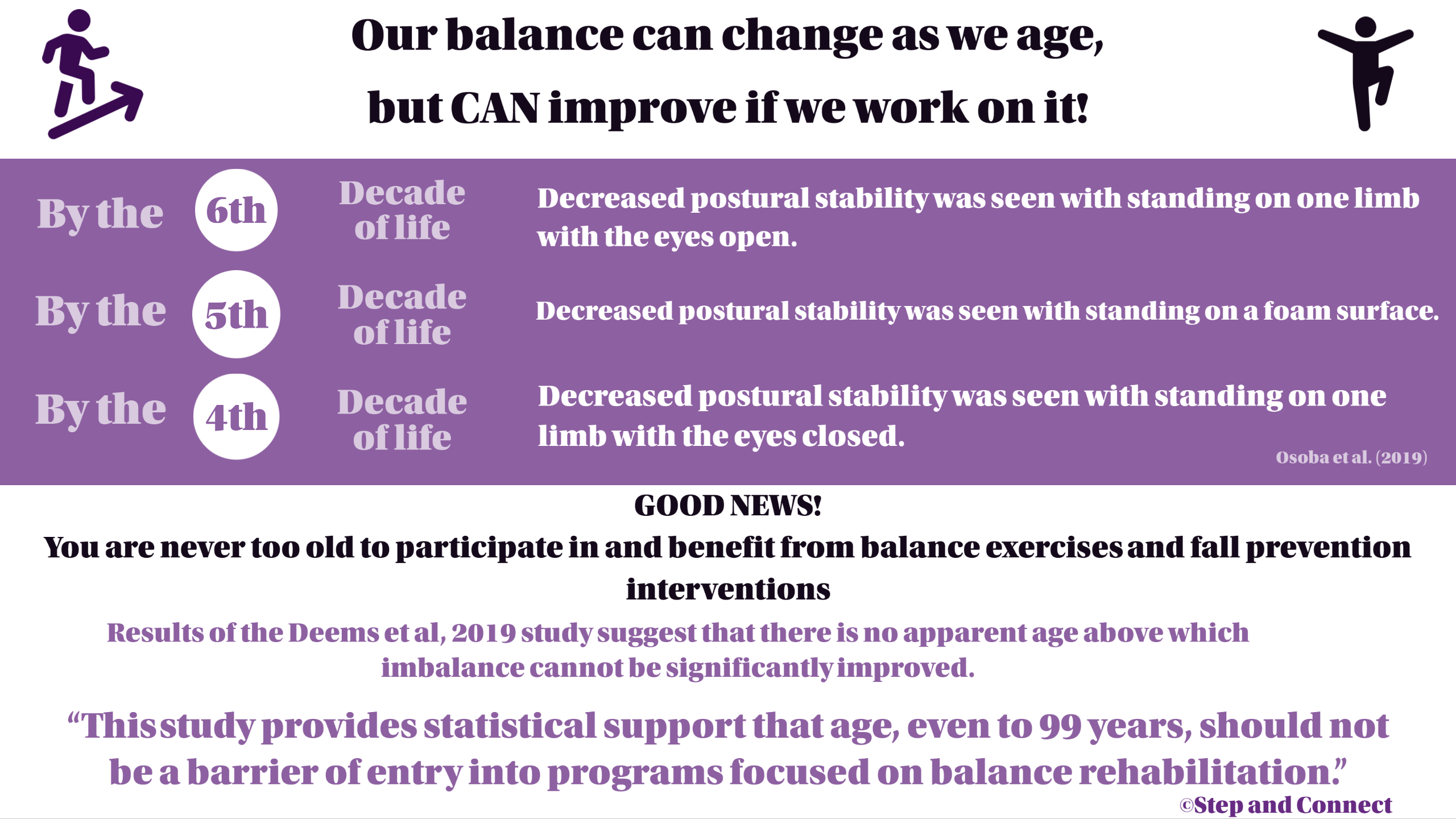
Sensory Integration
Lesson 1 - Overview
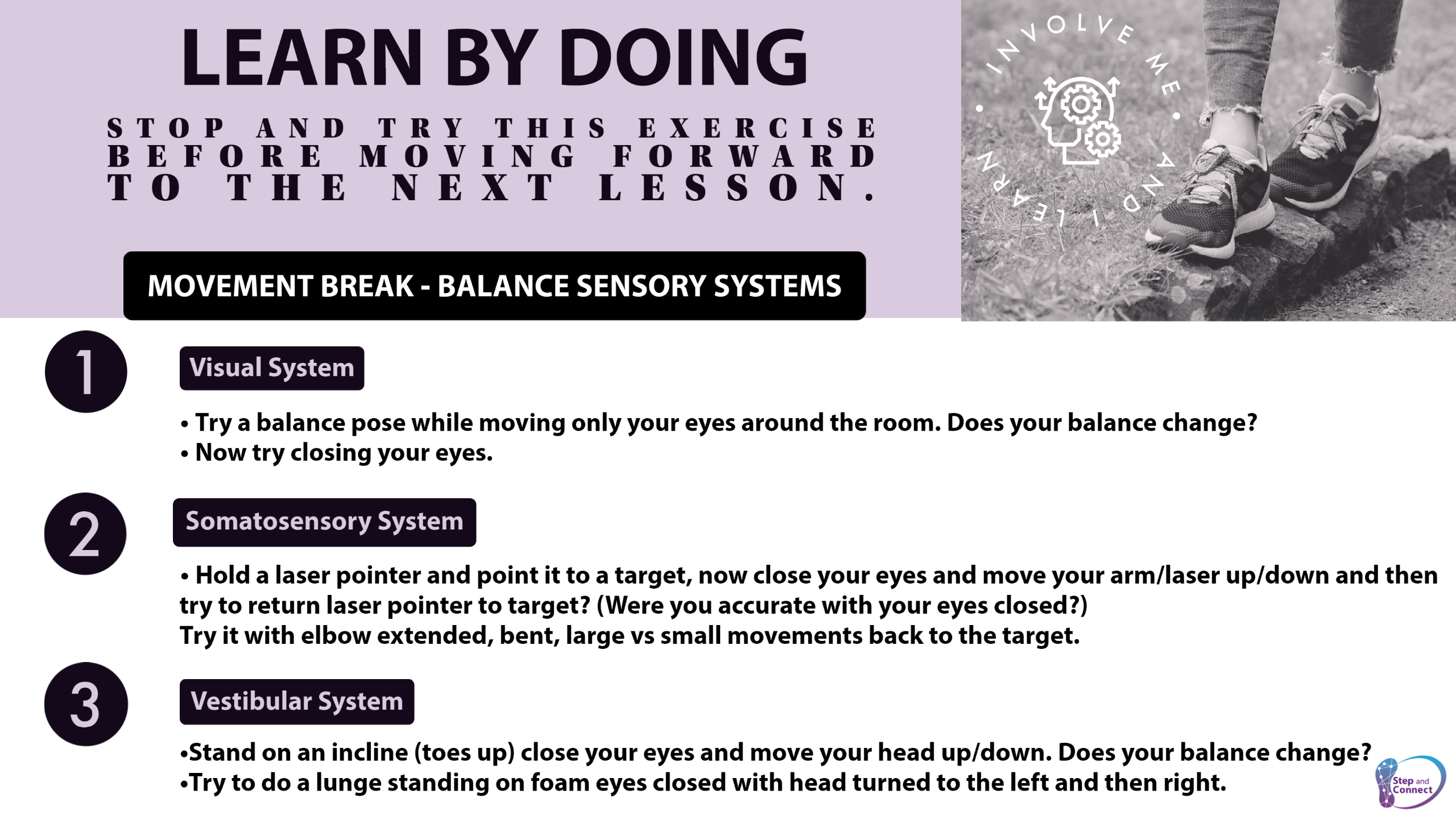
Good balance depends on:
correct sensory information from your eyes (visual system), muscles, tendons, and joints (proprioceptive input), and the balance organs in the inner ear (vestibular system).
The brain stem makes sense of all this sensory information in combination with other parts of the brain.
Once your brain stem sorts out all of this information, it sends messages to the eyes and other parts of your body to move in a way that will help you keep your balance while you are moving.
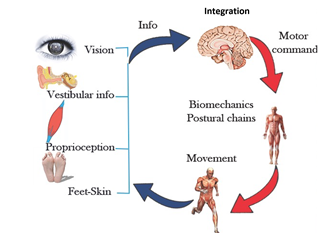
Studies have shown that in a well-lit environment with a firm base of support, healthy subjects rely on somatosensory 70%, vision 10% and vestibular 20% (Peterka RJ, Benolken (2002) Sensorimotor integration in human postural control. J Neurophysiol 88(3):1097–1118)
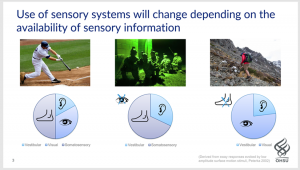
From the article: Horak FB. Postural orientation and equilibrium: what do we need to know about neural control of balance to prevent falls?. Age and ageing. 2006 Sep 1;35(suppl 2):ii7-11.
“When healthy subjects stand on an unstable surface, they increase sensory weighting to vestibular and vision as they decrease dependence on surface somatosensory inputs for postural orientation.
Ability to reweight sensory information depending on the sensory context is important for maintaining stability when moving from one sensory context to another, such as from a moving boat to firm ground. Individuals with loss of somatosensory, vestibular or visual input from pathology are limited in their ability to reweight postural sensory dependence and thus, are at risk of falls in particular sensory contexts. In addition, some central nervous system disorders may impair the ability to quickly reweight sensory dependence, even when the peripheral sensory systems are intact”
Horak, Fay. (2009). Postural Control. 10.1007/978-3-540-29678-2_4708.
Sensory Integration Training
To integrate all the balance sensory systems you can change the surface and/or visual input.
You can use different tools such as compliant surfaces (inclines, foam pads, wobble boards, tilt boards) so you cannot rely on the somatosensory system.
To decrease reliance on the visual system you can use dribble glasses as shown in the video below, use sunglasses or dim lighting, perform eyes closed activities or OPK (optokinetic therapy).
Dribble glasses help players develop basketball handling by forcing players to look up when dribbling and not at the ball. Players have better court vision by keeping their heads up to watch opponents & make better passing, shooting & dribbling decisions.
Can be used similarly in balance training depending on the goal (i.e decrease visual dependence, improve proprioception, train to look up when stepping, scan the environment, clients see the entire “court” environment to be able to anticipate obstacles etc... )
You can also challenge a client by changing the speed of transferring from one surface to another.
Try adding visual exercises or standing on compliant surfaces such as foam pads during your strength training. Can perform in different positions (1/2 kneeling, standing, lunges, single leg stance…)
Great article to demonstrate the importance of adding unstable surfaces to strength training to improve strength, balance, functional gains and decrease fear of falling.
-There was a significant improvement in balance performance in both the stable and unstable strength training groups using the Berg Balance Scale as an outcome measure.
-ONLY the strength training group on UNSTABLE surfaces experienced functional mobility gains (improved Timed Up and GO) and decreased concern about falling (FESI).
(Pirauá ALT, Cavalcante BR, de Oliveira VMA, et al. Effect of 24-week strength training on unstable surfaces on mobility, balance, and concern about falling in older adults. Scand J Med Sci Sports. 2019;29(11):1805‐1812. doi:10.1111/sms.13510)