Sensory Integration
Lesson 3 - Somatosensory System
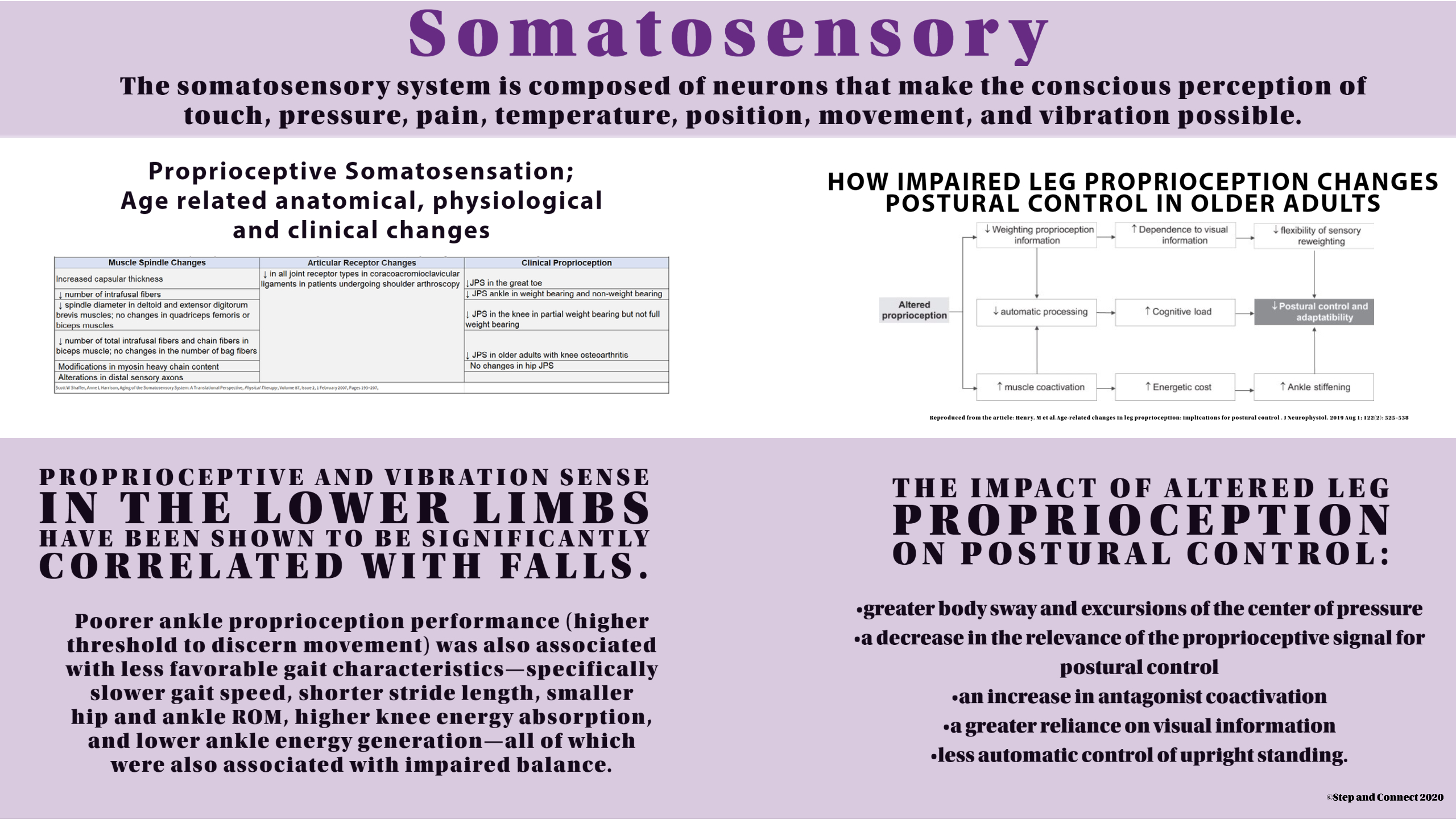
Somatosensory inputs
- Provides information about the direction of perturbation.
- Provides information about the texture and stability of the support surface so that appropriate postural strategies can be selected.
The somatosensory system functions in the body’s periphery, spinal cord, and the brain.
Periphery: Sensory receptors (i.e., thermoreceptors, mechanoreceptors, etc.) detect the various stimuli.
- Tactile Stimuli are external forces in physical contact with the skin that give rise to the sensations of touch, pressure, flutter, or vibration.
- Proprioceptive Stimuli are internal forces that are generated by the position or movement of a body part. Static forces on the joints, muscles and tendons, which maintain limb position against the force of gravity, indicate the position of a limb. The movement of a limb is indicated by dynamic changes in the forces applied to muscles, tendons and joints.
- Pain (nociceptive) Stimuli are tissue-damaging sources of energy that may be external or internal to the body surface.
Spinal Cord: Afferent pathways in the spinal cord serve to pass information from the periphery and the rest of the body to the brain.
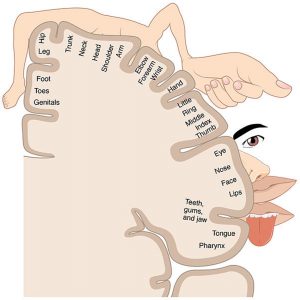
Brain: The postcentral gyrus contains Brodmann areas (BA) 3a, 3b, 1, and 2 that make up the somatosensory cortex.
- A cortical homunculus is the brain’s physical representation of the human body; it is a neurological map of the anatomical divisions of the body. The surface area of cortex dedicated to a body part correlates with the amount of somatosensory input from that area.
- For example, there is a large area of cortex devoted to sensation in the hands, while the back requires a much smaller area. Somatosensory information involved with proprioception and posture is processed in the cerebellum
Somatosensory inputs can provide confusing, ambiguous information about body center of mass motion because they cannot distinguish between body motion over a stable surface and surface motion under a stable body, such as when standing on a moving boat or pier.
In somatosensory training you can use:
- Resistance bands or weights to increase inputs at the joints, skin
- Vibration
- Tactile stimulation with different textures
- Eyes closed activities to decrease use of the visual system.